

Most organisations do not start with a compliance platform. They start with a folder, a spreadsheet and a very organised person. For a first ISO 27001 certification with a contained scope, that combination genuinely works — and recommending software before it is needed is a good way to waste money.
The trouble arrives later, and it arrives predictably. A second framework comes into scope. The infrastructure changes and the documents do not. Someone leaves and takes the context with them. And three weeks before the audit, a team that knows perfectly well what it does spends its evenings proving it.
This is a guide to what a compliance platform should actually do, what artificial intelligence can and cannot contribute, and how to tell a serious tool from a template library with a chatbot attached.
Why spreadsheets and shared folders start to fall short
The limit is rarely the volume of documents. It is the number of relationships between them.
A compliance system is not a set of files. It is a web of dependencies: this requirement is satisfied by that control, which is operated by this person, and demonstrated by that evidence, which expires on this date, and was affected by a change made last quarter. A spreadsheet can hold the list. What it cannot hold is the web.
So the failure mode is not «we lost a document». It is subtler and far more expensive: nobody can say with confidence whether the control that was documented in January is still running in October, and nobody notices until an auditor asks.
Three symptoms tend to appear together, and any of them is a reasonable signal that the folder has stopped scaling:
- The same evidence is collected several times over, once per framework, because nothing connects them.
- Preparing for the audit is a project in itself rather than an export of what already exists.
- When something changes in the infrastructure, no one can say which controls are affected without reading everything again.
The real problem: documentation without traceability
Plenty of organisations have excellent documentation and a weak compliance position. That sounds contradictory until you look at what an auditor is actually testing.
A policy proves intent. It does not prove execution. The question at audit is not «do you have an access control policy» but «show me that access was reviewed in the second quarter, who reviewed it, and what happened to the exceptions». That is a question about traceability, not about documents.
Traceability means a chain that survives inspection in both directions. From an obligation, you can reach the control that satisfies it and the evidence that proves it ran. From any piece of evidence, you can reach the requirement it supports and the person accountable for it. When that chain breaks, the documentation becomes a description of an organisation that may or may not still exist.
This is the actual job of a compliance platform. Everything else — templates, dashboards, generated text — is secondary to whether it keeps that chain intact.
What a good compliance platform needs to have
Seven capabilities separate a tool that changes how a team works from one that adds a login screen to the same problem.
1. Intelligent document management
Version control, ownership, review dates and approval status, with the history preserved. The point is not storage — any drive stores files. The point is that every document knows what it is for, who owns it, when it was last reviewed and which requirement depends on it.
A practical test: ask the tool which documents will expire in the next ninety days and who has to act on each. If that requires a manual search, the document management is a filing cabinet.
2. Risk assessment and treatment
Risk is where compliance either becomes a management discipline or stays a paperwork exercise. The platform should support identification, valuation, treatment decisions and residual risk, and it should keep the history of those decisions — because what an auditor examines is not only the current risk but how it has been managed over time.
It matters that risk connects to controls rather than living in a parallel register. A risk assessment nobody uses to prioritise controls is an artefact, not a decision-making tool.
3. Control and requirement matrix
This is the backbone. A single control frequently satisfies requirements in ISO 27001, ENS, NIS2 and DORA at once. Without a matrix that expresses those relationships, each framework is implemented as if the others did not exist, and the duplication is enormous.
The value shows up the second time. The first certification costs what it costs; the second should cost a fraction, because most of the work is already done and merely needs to be mapped. If it does not, the tool is not doing its job.
4. Evidence management
Evidence is what turns a documented control into a demonstrable one, and it has a property documents do not: it expires. Screenshots, reports, logs, meeting minutes and test records all have a useful life, after which they prove only that something was true once.
A serious platform tracks the currency of evidence, warns before it lapses, links each item to the control it supports, and preserves the history. «We have the evidence somewhere» is not a position you want to defend in front of an auditor.
5. Internal audit and non-conformity tracking
Internal audit is a requirement of the standard, not an optional extra, and it is where organisations most often improvise. The platform should support planning, execution, findings, corrective actions and verification of closure.
The metric that reveals maturity here is recurrence. A finding that keeps coming back year after year indicates a corrective action that treated the symptom. A tool that does not let you see that pattern is hiding the most useful signal you have.
6. Task and ownership management
Every control needs a name attached. Not a department — a person. And every task needs a date, a state and a verification step.
This is the least glamorous capability and often the one that decides whether the system stays alive. Compliance dies of diffuse responsibility far more often than of technical difficulty.
7. Executive reporting
Leadership does not need a control inventory. It needs to know whether the organisation is exposed, where, and what it costs to fix. Reporting should express status, risk and priority in terms a board can act on.
A reliable indicator of a weak tool is reporting that counts activity — documents created, tasks completed — instead of expressing position. Activity is not progress.
What AI can genuinely contribute
Artificial intelligence has been added to a great many compliance products in the last two years, and the honest summary is that it helps considerably in some places and not at all in others. Six uses hold up in practice.
Reviewing existing documentation
This is the strongest use and the least glamorous. Reading a body of existing documentation against a framework, identifying what is covered, what is partially covered and what is missing, is exactly the kind of thorough, repetitive comparison that machines do well and people do slowly.
Improving what already exists
Most organisations do not need documents written from nothing. They need existing documents brought up to standard: filling gaps, aligning terminology, adjusting to a new version of a framework. Starting from your material rather than a generic template preserves the operational reality your team already captured.
Creating documentation that does not exist
When a document genuinely is missing, generating a first draft saves real time — with one condition attached, which is that a draft is a starting point and not a deliverable. Documentation that describes a process nobody follows is worse than no documentation, because it creates a non-conformity where there was only a gap.
Mapping controls across frameworks
This is where the time savings are largest. Establishing which ISO 27001 control satisfies which NIS2 obligation, and what remains uncovered, is laborious cross-referencing work — and it is the foundation of managing several frameworks without triplicating effort. The comparison between ENS, ISO 27001, NIS2 and DORA sets out how much they overlap.
Detecting inconsistencies
Documentation drifts. A policy states one retention period, a procedure states another; a document refers to a role that no longer exists. These contradictions are hard to spot by reading and easy to spot by comparison — and they are precisely what an auditor finds.
Anonymising sensitive information
Any AI-assisted review involves sending documentation somewhere for processing. Anonymisation before processing is what makes that acceptable, and we return to it below because it deserves more than a line.
What a compliance platform should not do
A tool that draws no boundaries around itself is a warning sign, so it is worth being explicit about the limits.
It should not replace the auditor. Conformity is declared by professional judgement against evidence, and no platform is in a position to certify itself.
It should not take risk decisions with business impact. Accepting a residual risk is a management decision with consequences, and it needs a person who answers for it.
It should not generate documentation nobody reviews. Volume of generated text is the easiest metric to inflate and the least related to being compliant.
And it should not present interpretation as certainty. Regulatory requirements admit reading; a tool that never expresses doubt is not being confident, it is being unhelpful.
The underlying principle is simple enough: automation should remove mechanical work so the team spends its time on judgement. A platform that automates the judgement removes exactly the part that carries the value.
ISO 27001, ENS, NIS2 and DORA: why silos are expensive
Organisations frequently end up managing frameworks as separate projects, with different owners, different documentation and different calendars. It is understandable — they arrive at different moments, often driven by different commercial pressures — and it is one of the most expensive habits in the field.
The four overlap substantially. Access control, incident management, business continuity, third-party risk, asset inventory and awareness appear in all of them, expressed differently. Evidence generated once can serve several, provided something records the relationship.
The practical consequence of silos is not only duplicated effort. It is contradiction: the same control documented three ways, three sets of evidence with different criteria, and three answers to the same auditor question.
If your organisation faces more than one, it is worth understanding the relationship between the four frameworks before deciding how to structure the work — and where each of ISO 27001, NIS2 and DORA genuinely diverges.
Vulnerability management is part of compliance too
This is one of the most common structural gaps. Compliance sits with one team, vulnerability management with another, and the evidence flows between them by email once a year.
All four frameworks require the identification, evaluation and treatment of technical vulnerabilities. That means the output of a vulnerability management programme is compliance evidence — scan coverage, remediation times, exception handling, criticality criteria.
When the two are connected, evidence is generated as a by-product of operations. When they are not, the compliance team reconstructs at audit time what the security team already knew, which is both slower and less accurate.
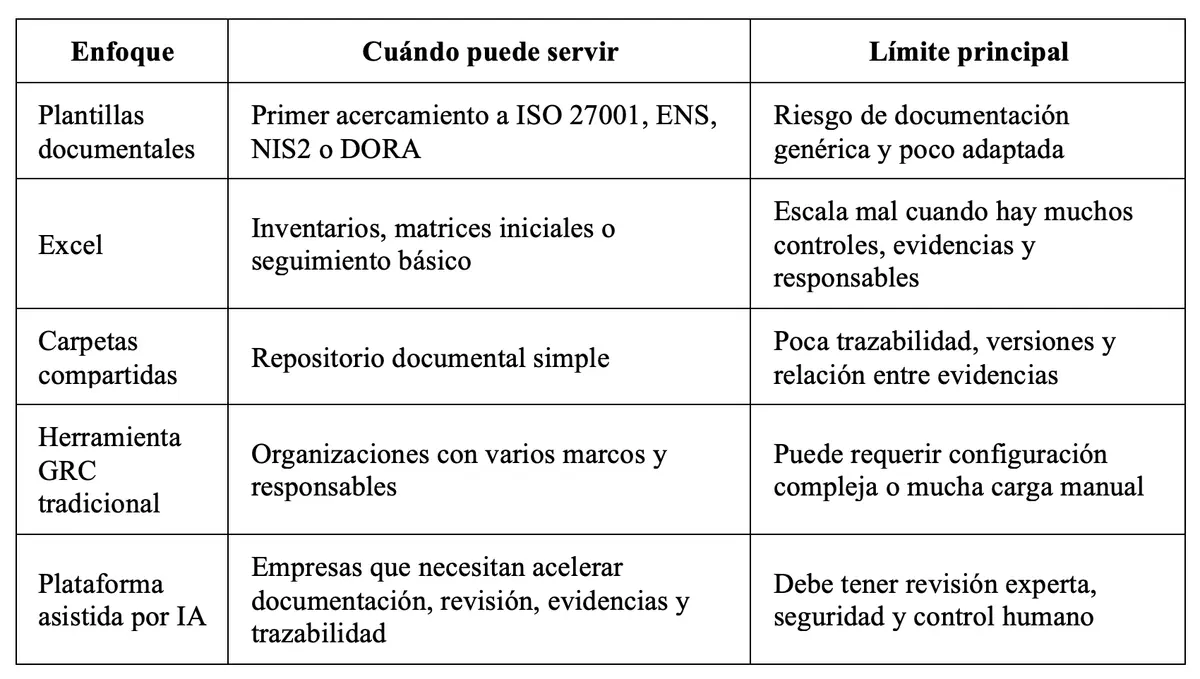
Spreadsheet, templates or platform: when each makes sense
Not every organisation needs a platform, and pretending otherwise is a sales argument rather than an assessment.
A spreadsheet is reasonable with a single framework, a contained scope and a stable team. It is cheap, everyone understands it, and for a first certification it often suffices.
Templates help when the gap is knowing what a document should contain. They stop helping the moment maintenance becomes the problem, which is generally after the first year.
A platform earns its place when several frameworks coexist, when the scope spans more than a handful of systems, when evidence has to be maintained continuously rather than assembled annually, or when the team has changed and the context lives in someone's head.
Checklist: what to review before choosing
Ten questions that sort the market faster than any feature comparison:
- Can it show the full path from a specific requirement to the evidence that proves it?
- Does it map controls across frameworks, or does each one start from scratch?
- Does it track evidence expiry and warn before it lapses?
- Does every control and task have a named owner and a date?
- Does it keep an auditable history of changes, exceptions and decisions?
- Does the reporting express risk and priority, or does it count activity?
- What happens to your documentation during processing, and is it anonymised?
- Where is the data hosted and under which jurisdiction?
- How is the vendor's own AI governed, and can they explain an automated suggestion?
- Can you get your data out in a usable format if you leave?
The last three are the ones most often skipped, and they are the ones that hurt later.
NormexAI: accelerating compliance without losing control
This is the problem NormexAI was built for. It turns regulatory requirements into operational controls, evidence and audit-ready deliverables, across ISO 27001, ENS, NIS2 and DORA, with traceability maintained end to end.
The design principle is that the platform structures and accelerates the work while the judgement stays with the people accountable for it. It reviews existing documentation against a framework, identifies gaps, drafts what is missing, maps controls between frameworks and keeps evidence linked to the requirements it supports — and it anonymises sensitive information before processing.
The operational side of running a management system this way is set out in automating ISO 27001, and the criteria for evaluating this category of tool in how to choose an AI compliance platform.
Why anonymisation matters so much in AI-assisted compliance
Compliance documentation is among the most sensitive material an organisation holds. It describes the architecture, names the systems, identifies the people responsible and, in a risk assessment, sets out precisely where the organisation is weakest.
Handing that to an AI system for processing without anonymisation creates a problem that is both a security exposure and, potentially, a compliance one — which would be a memorable irony given the purpose of the exercise.
Anonymisation before processing means the model works with the structure and the content it needs to assess, without the identifiers that would make a leak damaging. It is a design decision, not a configuration option, and it is a fair question to put to any vendor in this space.
From documentation to a living system
The shift worth aiming for is from compliance as a periodic project to compliance as a continuous operation.
In the project model, effort concentrates before the audit, evidence is reconstructed retrospectively, and the organisation is genuinely compliant for roughly the period around the certification. In the continuous model, evidence is generated as operations run, deviations surface when they occur, and the audit is an inspection of something that already exists.
The difference is not effort — it is comparable, and after the first year usually lower. The difference is timing, and therefore risk. An organisation that only knows its position at audit time has no idea what its position is for the remaining eleven months.
How a compliance platform should be rolled out
Seven steps, in this order, because the order is what prevents the common failures.
1. Define the scope
Which systems, which processes, which frameworks. Scope creep is the single most reliable cause of stalled compliance projects, and it usually starts with an ambiguous boundary rather than a deliberate expansion.
2. Review what already exists
Before writing anything new. Most organisations have more usable material than they think, scattered and unmapped. Starting from the existing base preserves operational reality and avoids describing a process that nobody follows.
3. Identify the gaps
Against the framework, honestly, and including partial coverage. A control that is half implemented is a more dangerous entry in a gap analysis than one that is absent, because it looks finished.
4. Create or improve documentation
Now, and only for what the gap analysis identified. Documents that exist because a template offered them serve nobody.
5. Link controls and evidence
This is the step most often skipped under time pressure, and the one that determines whether the system is auditable. A control without linked evidence is an intention.
6. Assign owners and track
Names, dates, states. And a review cadence that does not depend on the audit calendar.
7. Prepare for audit and continuous improvement
If the previous six steps were done, this one is an export. If it is a project, something upstream was skipped.
Common mistakes when choosing a platform
Choosing on template count
Templates are the easiest thing to accumulate and the least differentiating. What matters is what happens after the document exists.
Assuming AI replaces the expert
It accelerates and structures. Interpretation, risk decisions and validation remain human — and a vendor who implies otherwise is describing a liability transfer.
Separating compliance from cybersecurity
They generate each other's evidence. Managed apart, both are more expensive and less accurate.
Not reviewing the tool's own security
You are about to give it your architecture, your risks and your weaknesses. Its hosting, encryption, access model and data handling are legitimate due diligence, not paranoia.
Not defining internal owners
No platform survives diffuse responsibility. This is the failure that kills most implementations.
Producing documents nobody uses
If the document does not change how the organisation operates, it is a liability at audit rather than an asset.
Which organisations benefit most
The pattern is fairly consistent. Organisations facing a second framework after a first certification, where duplication is about to become visible. Regulated entities under NIS2 or DORA with an existing management system that needs extending. Suppliers to the public sector needing ENS alongside ISO 27001. Companies whose compliance context lives in the head of one person who is now overloaded. And teams that certified successfully and have watched the system go quiet between audits.
Conversely, an organisation with one framework, a narrow scope and a stable team is usually better served by disciplined use of a spreadsheet and the money spent elsewhere.
Useful automation does not produce paperwork, it builds traceability
The measure of a compliance platform is not how much documentation it generates. It is whether, on any given day and without warning, the organisation can show that a specific requirement is satisfied by a specific control, operated by a named person, and evidenced within its useful life.
Everything else — the templates, the generated text, the dashboards — is instrumental to that. A tool that produces a great deal and traces very little has automated the wrong half of the problem.
If you want to structure your compliance with an AI-assisted platform, you can see how NormexAI approaches it, review our GRC and compliance services, or get in touch to discuss a specific scope.
Frequently asked questions
Does compliance software replace a consultancy or an auditor?
▾
No. A platform structures work, maintains traceability and removes mechanical effort, but the interpretation of requirements, risk decisions with business impact and the final declaration of conformity remain human. An auditor assesses evidence against professional judgement, and no tool can certify itself. What good software does is make the auditor's job an inspection rather than an excavation.
Can a platform generate all the documentation for ISO 27001 or ENS?
▾
It can generate solid first drafts, and that saves real time. It cannot produce final documentation without review, because a document has to describe how your organisation actually operates. Generated documentation that describes a process nobody follows is worse than a gap: it creates a non-conformity where there was only an absence. Treat generated text as a starting point that a person who knows the operation then adapts.
Can AI review existing documentation reliably?
▾
This is where it performs best. Reading a body of documentation against a framework, marking what is covered, partially covered or missing, and flagging contradictions between documents is thorough, repetitive comparison work — exactly what machines do well and people do slowly. The output still needs expert review, but as a starting point it compresses weeks of gap analysis considerably.
Why does anonymisation matter so much here?
▾
Compliance documentation describes your architecture, names your systems and, in a risk assessment, states precisely where you are weakest. Sending that for AI processing without anonymisation creates a security exposure and potentially a compliance problem of its own. Anonymising before processing lets the model assess structure and content without the identifiers that would make a leak damaging. It is a fair question to put to any vendor.
Is NormexAI only useful for ISO 27001?
▾
No. It is designed for ISO 27001, Spain's ENS, NIS2 and DORA, and the strongest case for it is precisely when several of those coexist. The four overlap substantially in access control, incident management, continuity and third-party risk, so a single control often satisfies requirements across frameworks. Mapping those relationships is where most of the duplicated effort disappears.
Can it help with ENS specifically?
▾
Yes. Spain's Esquema Nacional de Seguridad applies to public sector bodies and to their suppliers, which brings a large number of private companies into scope. Because ENS shares a substantial part of its control set with ISO 27001, an organisation already certified can reuse a great deal of existing evidence — provided something records which control satisfies which requirement in each framework.
Does it help with NIS2 and DORA?
▾
Yes, and these are the frameworks where traceability matters most, because both carry incident notification duties with defined deadlines and both require demonstrable governance rather than documented intent. Evidence generated for an existing management system covers a meaningful share of what they demand, but only if the relationships between requirements and controls are recorded rather than reconstructed.
Is having a platform enough to be compliant?
▾
No, and any vendor suggesting otherwise is overselling. A platform is an instrument. Compliance requires controls that genuinely operate, people accountable for them, evidence generated within its useful life, and management involvement in risk decisions. What a platform changes is the cost of sustaining all that over time, and whether you can demonstrate it on any given day rather than only around the audit.